
Where can a home battery be installed?
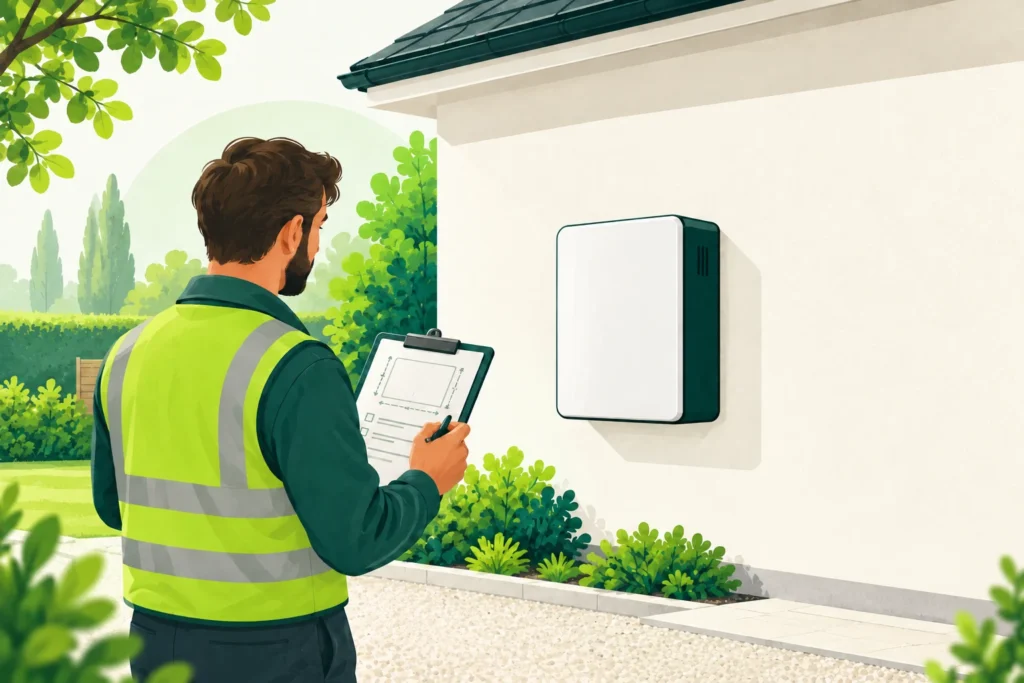
The best battery location depends on the building, the product and its surroundings. Use this guide to prepare for a proper installation survey.
Estimated reading time: 5 minutes
Key Takeaways
- Identify suitable locations for home battery installation, such as outdoor walls, garages, or utility rooms, based on the model and safety measures.
- Conduct a thorough survey with your installer to assess the space and ensure it meets installation standards, including clearance and ventilation requirements.
- BSI’s PAS 63100:2024 sets out domestic battery fire-safety requirements. Ask your installer which standards and safety measures apply to the proposed location.
- Always consider future access, weight support, and temperature factors when choosing the installation spot for your home battery.
- Review installation quotes carefully, focusing on location, supporting work, and necessary permissions before booking the work.
Table of contents
A home battery may be suitable for an outside wall, garage or another carefully assessed location. The right spot depends on the battery model, the building and the safety measures needed. An empty wall is a starting point for a survey, rather than confirmation that a battery can go there.
Energy Saving Trust identifies garages, external walls and utility rooms as possible locations, depending on the product. Before ordering, ask your installer to confirm the exact position, the equipment around it and any building work in the written quote.
Start with a survey of the location
Show the installer how you actually use the space. A garage may also store bicycles, garden tools and household supplies. A passage beside the house may be the only practical route to the garden. A cupboard that looks spare today may be needed when another appliance is replaced.
Ask the surveyor to mark the proposed equipment positions and the area that must remain clear. Include any separate inverter, controls and electrical equipment. A neat product photograph rarely shows everything that your own installation needs.
It helps to compare two possible locations during the survey. You can then see whether a slightly less convenient position avoids substantial alterations or leaves better access for maintenance.
What do the installation standards say?
BSI’s PAS 63100:2024 sets out domestic battery fire-safety requirements. Its starting point is outdoor installation where practicable. Indoor locations need appropriate ventilation and fire-resisting separation. It also addresses alarms and protection of escape routes.
Ask the installer which standards apply to your design, rather than relying on a sales description such as “indoor-rated”. Product suitability and the suitability of a particular room are separate checks.
There is also a timely standards change. The IET confirms that BS 7671 Amendment 4 was published on 15 April 2026, with the previous edition withdrawn on 15 October 2026. If your installation is being planned around that date, ask which edition the design and certification will follow.
Update checked 22 October 2026: the transition ended on 15 October. The IET identifies BS 7671:2018+A4:2026 as the current edition for new electrical installation work and certification. Ask the installer which requirements apply to your proposed design.
Installing a battery outside
An outdoor position needs equipment approved for that environment. Ask the installer to check the exact model’s documentation, including the inverter and any other components, rather than assuming every item has the same protection.
Under PAS 63100, outdoor batteries must not be within one metre of doors, windows, ventilation ports or escape routes. This is one part of the assessment; it is not a complete siting rule.
Tell the surveyor about standing water, overflowing gutters or water running down the wall in heavy rain. Tesla’s Powerwall 2 instructions, for example, require a location protected from flooding and caution against nearby water sources. Follow the instructions for the product actually being fitted.
Also discuss how visible the equipment will be and whether permissions need checking. An external installation can raise planning or building-control questions in some circumstances, as BSI notes. For a rented, leasehold or listed property, resolve the relevant consents before booking work.
Installing a battery in a garage or utility area
A garage can offer useful space, but the installer still needs to assess its construction and relationship to the house. Ask how the design deals with doors into the home, anything stored nearby and the everyday movement of vehicles.
Tesla’s owner instructions advise keeping its Powerwall out of a vehicle’s driving path. Even if your chosen battery is a different brand, tell the installer where the car, bins and bicycles normally sit so they can assess the proposed location properly.
For an indoor proposal, ask the installer to explain the ventilation, separation and alarm arrangements shown in the design. Include the cost of those measures in your comparison. A quote based only on mounting the unit may not describe the complete job.
Can a battery go in the loft or under the stairs?
PAS 63100 excludes lofts, roof spaces and voids, as well as sleeping rooms and specified escape-route locations. Do not assume a loft is suitable because the existing solar inverter is already there. An under-stairs proposal needs particular scrutiny of the escape route and enclosure.
If you already have a battery in an older installation, ask a competent installer to review its circumstances. The IET explains that a change in wiring standards does not, by itself, make an older installation unsafe. Its actual condition and design need assessment.
Check weight, temperature and future access
Ask how the unit’s weight will be supported and how it will be brought into position. For perspective, Tesla lists Powerwall 3 at 130kg. Other products differ, so use the proposed model’s figures rather than guessing from its appearance.
Temperature deserves a separate discussion. Enphase’s temperature guidance explains that battery charging and discharging can be reduced at less favourable temperatures. A broad operating range does not promise equal performance throughout that range. Ask about winter charging and direct summer sun at the suggested position.
Finally, think ahead. Could an engineer reach the equipment without dismantling cupboards? Would a future extension, garage conversion or garden gate affect access? If you might add storage later, ask what that would mean for the space. Our battery size guide covers capacity planning; physical installation space should be checked alongside it.
The most useful quote identifies the location, supporting work, clearances and permissions to resolve. Compare those details alongside the equipment in our home battery cost guide. That makes it easier to compare complete installations rather than just the price of the battery.
Wall-mounted or floor-standing battery?
The right choice depends on the exact product and the surveyed location. A wall-mounted arrangement needs a supporting structure and fixings suitable for the complete installed load. A floor-standing arrangement needs an appropriate base and usable floor space. Neither label removes the need for the manufacturer’s clearances, maintenance access, cable routes and location requirements.
Floor-standing does not necessarily mean freestanding or unsecured. For example, Tesla’s UK Powerwall 3 installation manual, checked on 23 October 2026, requires its wall bracket to secure the unit and also describes a ground-mounted configuration. That is a model-specific example, not an instruction for other batteries.
Ask the surveyor to compare both layouts on the actual site plan: which structure carries the weight, how the unit is secured, what space must stay clear, how it can be serviced or replaced, and whether extra building work is included in the quote. Do not choose solely because a catalogue photograph looks compact. Installation and structural decisions belong with competent professionals following the current product instructions.
Sources
Information checked on 1 October 2026.
- Energy Saving Trust: battery storage
- BSI: PAS 63100:2024 domestic battery fire-safety specification
- IET: Amendment 4 transition and existing installations
- Tesla UK: Powerwall models and physical specifications
- Tesla: Powerwall 2 owner safety and environmental instructions
- Enphase: battery temperature and performance guidance